Estimated reading time: 14 minutes
Last updated on June 8th, 2026 at 04:29 am
Most bathrooms get less thought than any other room in the house. Which is strange, considering you start and end every single day in one.
The result? Rooms that function perfectly well but feel cold, clinical, and somehow disconnected from the rest of the home — like a hotel bathroom you haven’t quite made peace with. Good lighting gone wrong. Hard surfaces everywhere. Nothing that says you.
The good news is that fixing it doesn’t always require a full renovation. Some of the most beautiful bathrooms out there were achieved with clever colour choices, layered lighting, a bit of aged wood, and the confidence to do something unexpected. These modern bathroom decor ideas pull from real homes — real decisions made by real people — rather than CGI showrooms. The goal is a bathroom that genuinely feels like yours.
- Before You Start: Think About What the Room Actually Needs to Do
- Lighting Is the One Thing Most People Get Wrong
- The multi-circuit approach
- What IP ratings actually mean
- Texture: The Antidote to That Cold, Shiny Feeling
- Flooring you might not have considered
- Panelling, wallpaper, and limewash
- Aged wood and fabric
- Colour: Choosing Something That Works at 7am and 10pm
- When to go bold
- The neutrals worth knowing
- Storage That Doesn't Make the Room Feel Like a Utility Cupboard
- The Personal Touch: Why It Matters More Than Any Single Design Decision
- Small Bathroom Ideas: Specific Problems, Specific Solutions
- Family Bathrooms: Practicality Doesn't Have to Mean Boring
- What You Can Do Without Building Work (Including if You're Renting)
- FAQs
Before You Start: Think About What the Room Actually Needs to Do
This sounds obvious, but most bathroom renovations start with aesthetics and forget function. A bathroom needs to energise you in the morning and help you decompress at night. Those are almost opposite things, and the best-designed bathrooms manage both.
Interior designer Nicola Harding frames it well: the bathroom is at least as important as any other room, yet it’s often invested with less love and personality. That tension — between its practical demands and its potential for real comfort — is exactly where most bathrooms go wrong.
So before picking tiles or paint colours, ask yourself what the room is missing. Is it warmth? Light? Storage you can actually use? A reason to linger? The answers will shape every decision that follows.
Lighting Is the One Thing Most People Get Wrong
If you only change one element of your bathroom, make it the lighting. Bad lighting — and most bathroom lighting is bad — is the single biggest reason spaces feel harsh, cold, and unflattering.
The default approach is a single ceiling fixture with a bright white bulb. It technically illuminates the room. It also makes everything look slightly like a crime scene.
The multi-circuit approach
The fix isn’t just swapping a bulb. It’s rethinking the whole system. Aim for at least two separate circuits — one for task lighting (around the mirror, for getting ready) and one for ambient light that lets you adjust the mood. Fit dimmers on both. Use warm-white bulbs throughout, not cool white or daylight.
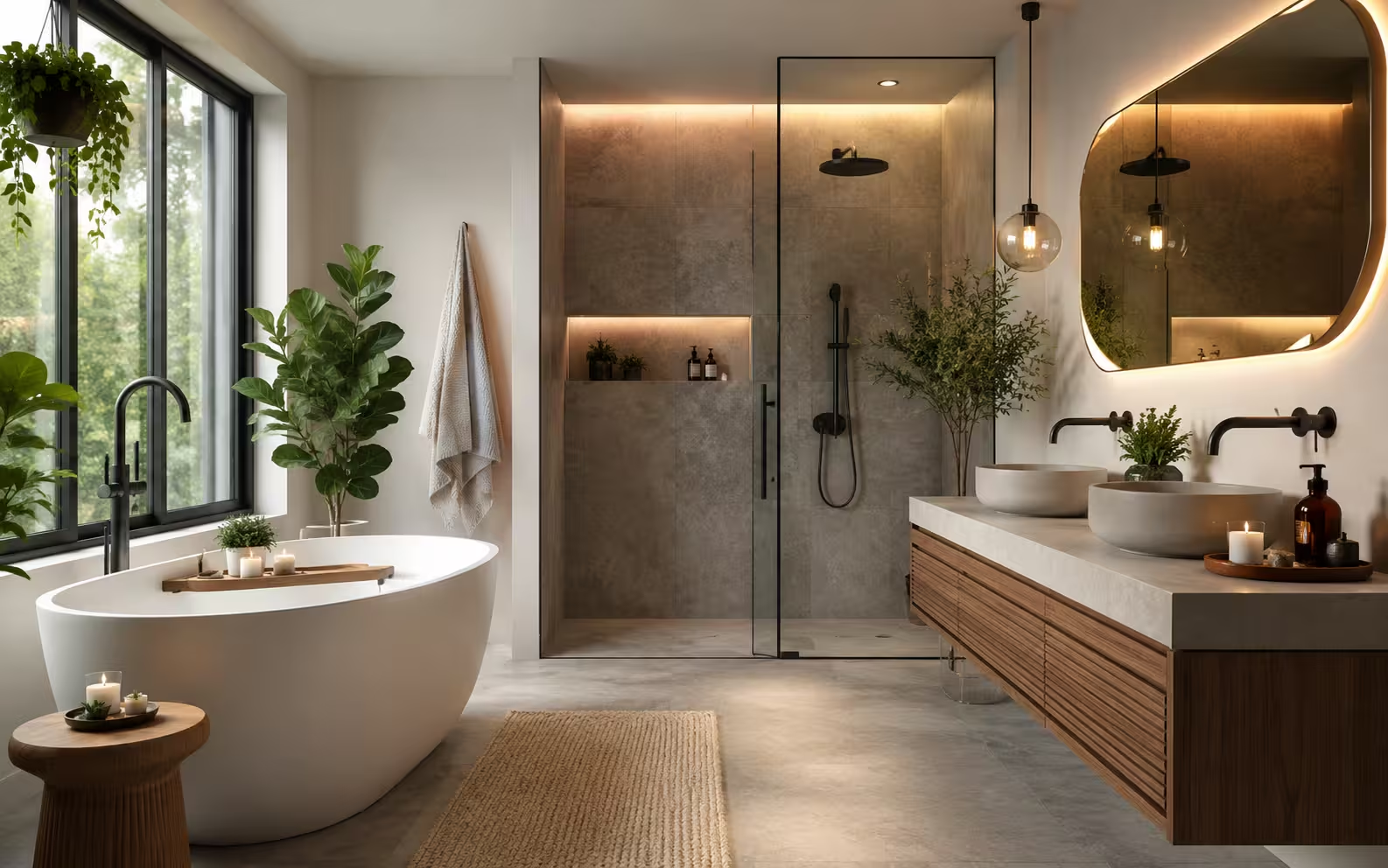
And here’s the detail most people miss: height. Most bathroom lighting sits at ceiling level and pushes light downward in the least flattering way possible. Try adding lower-level fittings — something close to skirting height that washes the floor with light. It sounds subtle, but the effect is immediate. The room suddenly feels like somewhere you’d actually want to be.
Keep ceiling spotlights to a minimum. They’re useful but rarely atmospheric on their own. A wall light either side of the mirror, combined with a single low pendant or floor-level fitting, will do far more for the room than a grid of recessed downlights ever will. For more specific product direction, our guide to the best lighting for bathrooms covers affordable options chosen by interior designers.
What IP ratings actually mean
You’ll see IP ratings mentioned whenever bathroom lighting comes up. IP44 means protected against water splashes — fine for most bathroom positions outside the immediate shower zone. IP65 or above is needed directly inside or above a shower. It sounds technical, but in practice: anything within 60cm of a shower or bath needs to be properly rated. Your electrician will know; just don’t let a beautiful light get installed in the wrong zone.
Texture: The Antidote to That Cold, Shiny Feeling
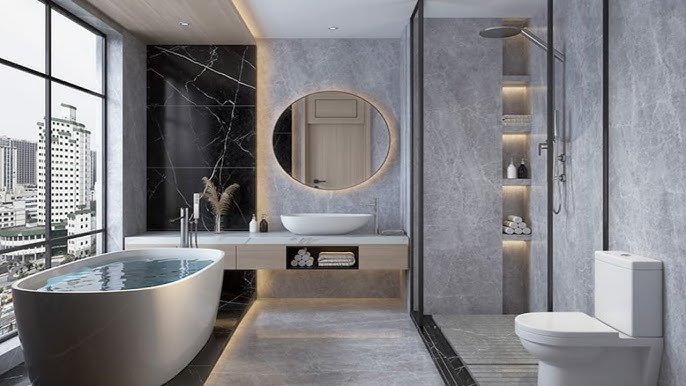
Hard surfaces are the default in bathrooms, and for good reason — they’re practical, water-resistant, and easy to clean. But all-hard everything is why so many bathrooms feel cold and echoy, even when the colour palette is warm.
The answer is layering in softness. Not in ways that create maintenance problems, but strategically.
Flooring you might not have considered
Before you tile the floor, consider a waterproof woven vinyl. It reads warmer underfoot, it’s genuinely practical, and it immediately differentiates the space from every other bathroom in the street. Paired with underfloor heating — which is more affordable than most people assume and straightforward for a builder to install — it transforms a cold morning experience completely.
If you do go with tile, choose something with some imperfection to it. A hand-finished zellige tile with an uneven glaze catches light differently to a flat ceramic tile, and that variation is what stops a room from looking like a catalogue page.
Panelling, wallpaper, and limewash
Instead of flat emulsion on every wall, consider what matchboard panelling does to a room. It adds depth, warmth, and an architectural quality that paint alone can’t achieve. Paint it in something soft — Edward Bulmer’s ‘Milk White’ or Farrow & Ball’s ‘Arsenic’ both look exceptional on panelling — and suddenly a simple, affordable material looks considered and intentional.
Bathroom wallpaper is worth taking seriously too. More papers are moisture-tolerant than they used to be, and a single papered wall can completely change the character of a room. Chinoiserie, botanical prints, bold stripes — bathrooms are small enough that you can commit to something you’d never risk in a living room. If you’re not sure where to start, our bathroom wallpaper ideas gallery has strong inspiration for every style.
Limewash finishes — like Pure & Original’s ‘Fresco’ — give walls an uneven, organic quality that no other paint finish replicates. It’s not for everyone, but in the right bathroom it’s genuinely extraordinary.
Aged wood and fabric
Wherever you can squeeze in some aged wood, do it. A wall-hung cabinet, a stool beside the bath, a mirror frame — these elements introduce warmth that no tile or paint can fully replicate. They also improve the acoustics. A fully tiled, fully hard bathroom bounces sound around in a way that feels subtly uncomfortable. Add fabric — a curtain beneath the basin, a blind, a bath mat with real texture — and the room softens audibly as well as visually.
Colour: Choosing Something That Works at 7am and 10pm
Colour in bathrooms is a topic where a lot of advice falls flat because it tells you what to choose without explaining why. Pink is a good everyday bathroom colour — but the reason matters.
Pink reads differently depending on the light. In the morning, with natural daylight, a soft pink feels fresh and calm. In the evening, under warm artificial light, it becomes cosy and nurturing. It’s one of the few colours that genuinely serves both moods. Pair it with a muted sage green for something restful, or with mustard for a bit of unexpected energy.
Green has had a long moment in bathroom design, and it’s earned it. Whether that’s a deep Farrow & Ball ‘Hague Blue’-adjacent shade on a bath, or a soft ‘Cooking Apple Green’ on the walls, it reads natural and grounded in a way that white and grey rarely do.
When to go bold
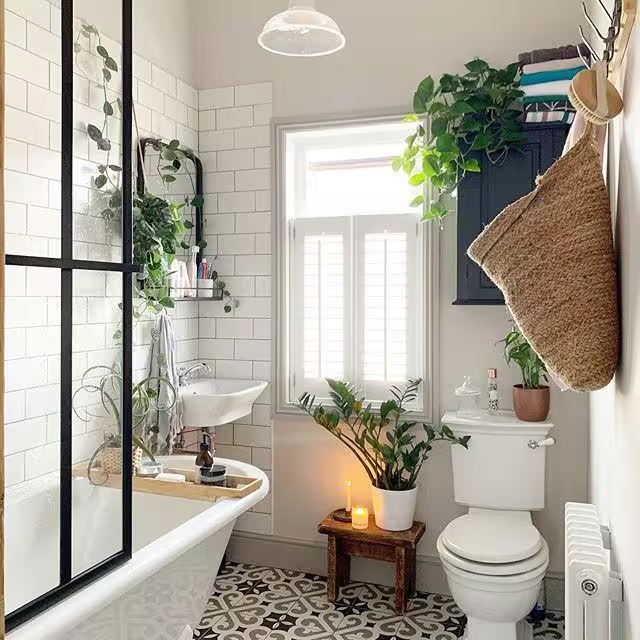
Small bathrooms are actually the best place for bold decisions. In a larger room, a heavily patterned wallpaper can feel overwhelming. In a small room, it feels immersive and intentional — more like a jewel box than a design risk. Don’t let a room’s size make you timid. If anything, go the other way.
One designer’s own shower room has bright yellow tiles, a ceiling painted in yellow gloss, a boldly patterned wallpaper, and a red and white check curtain below the sink. On paper that sounds chaotic. In a small space, it works completely — because the scale contains it.
The neutrals worth knowing
If bold isn’t your thing, the neutrals that actually feel warm rather than cold are worth knowing. Farrow & Ball’s ‘Wimborne White’, Little Greene’s ‘China Clay’, Edward Bulmer’s ‘Clover’ used as an almost-neutral — these are paints that photographers keep returning to because they read well under different light conditions and play kindly with the warm tones of natural materials. Explore more bathroom colour ideas if you’re still deciding on a direction.
Storage That Doesn’t Make the Room Feel Like a Utility Cupboard
Bathrooms become frustrating fast when storage is wrong. And “wrong” usually means either not enough of it, or the kind that turns the room into an organised medical cabinet rather than a space you want to be in.
A vintage wall cabinet for medicines and skincare is both practical and characterful — far more so than a sleek white box. A chest of drawers for clean towels reads as furniture, which is the point: the more a bathroom can feel like a room rather than a wet room, the better. Colourful baskets corralling bath toys for children, ceramic shelves for soap and small objects, hooks above a radiator rather than a towel rail — all of these solve practical problems while adding personality rather than removing it.
The one piece of counter-intuitive advice worth repeating: skip the expensive towel rail. They heat slowly, they’re rarely large enough, and folded towels dry badly on them. A good chunky radiator with hooks above it will give off more heat, dry towels faster, and cost considerably less. It’s one of those things that seems too simple to be right until you try it.
For more ideas on making storage work stylistically, bathroom shelf styling is worth reading before you commit to anything built-in.
The Personal Touch: Why It Matters More Than Any Single Design Decision
This is the part most bathroom guides skip, which is why so many renovations end up looking finished but not felt. The difference between a beautiful bathroom and a truly memorable one is usually something personal — something that has nothing to do with tiles or fittings.
Art belongs in bathrooms. Books belong in bathrooms. Family photographs, a piece of embroidery, a framed map, a print you’ve loved for years — all of it works. One of the most memorable bathrooms in the House & Garden archive belongs to a designer who hung a framed poem by a 17th-century nun above the bath. Given to her by her parents when they moved house, it has a double meaning she thinks about every morning. Nothing expensive. Nothing you’d find in a tile shop. Completely unforgettable.
This is the stuff that makes a bathroom yours. And you can’t buy it — you just have to notice it.
Small Bathroom Ideas: Specific Problems, Specific Solutions
Small bathrooms have their own set of constraints, and generic advice rarely helps. Here’s what actually works.
Vertical panelling adds apparent height to a low-ceilinged or awkwardly shaped room — the eye follows the lines upward. A porthole window or a high-placed window keeps light in while providing privacy. Mirrored panels on one wall expand the sense of space without architectural work. A floating basin, rather than a pedestal, makes the floor read as larger.
For the shower: rather than a standard cubicle, consider reconfiguring the room’s layout to create a proper shower enclave — an arched opening, tadelakt-lined walls inspired by Moroccan hammam design, or simply a large wetroom area with a glass screen instead of a fully enclosed box. The proportions change entirely.
If you’re working with a genuinely tiny space, the small bathroom decor hacks guide goes deeper on layout and fixture choices.
Family Bathrooms: Practicality Doesn’t Have to Mean Boring
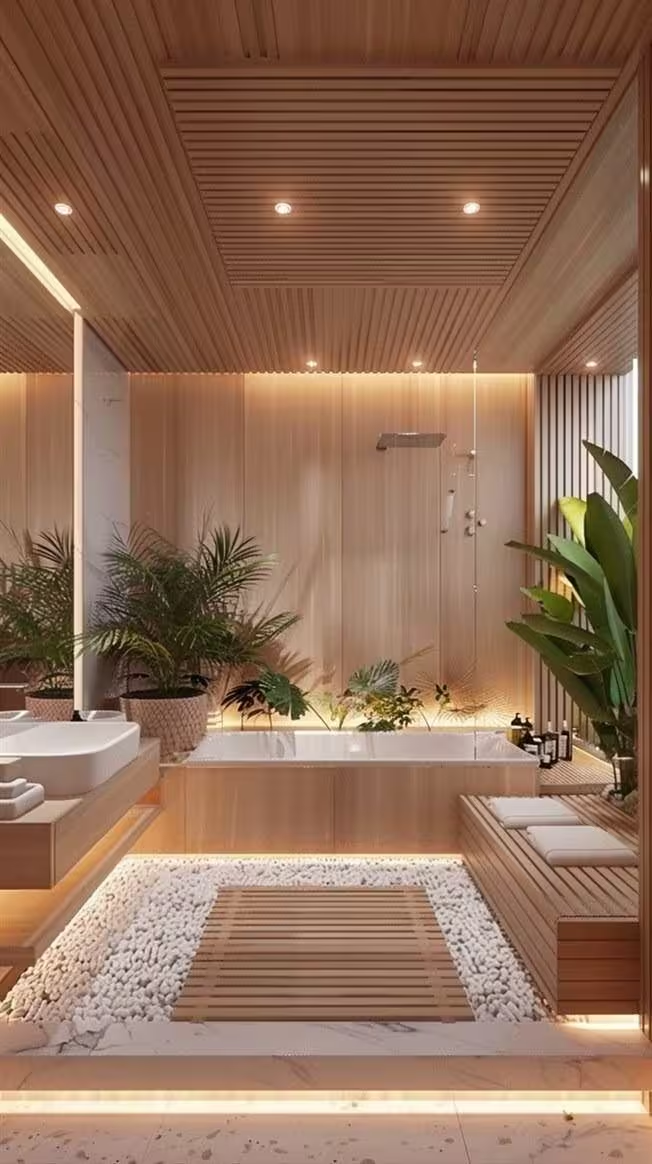
Family bathrooms take a beating. They need to be easy to clean, hard-wearing, and functional for multiple people with completely different needs. None of that means they have to be beige and characterless.
Some of the most joyful bathrooms in real homes are family bathrooms. Candy-coloured tiles from an affordable tile retailer, arranged in a creative pattern, cost no more than standard tiles but look completely bespoke. Vintage enamel baths and sinks — often found through eBay or architectural salvage — are more durable than many modern equivalents and bring instant character. A hand-painted mural, a bold wallpaper, a shelf of objects the children chose themselves — these details cost almost nothing and make a room genuinely lovable rather than merely functional.
The marble-surround trick is worth stealing too: one designer added a wide marble ledge around the bath in a bathroom shared by three children, purely because it creates usable surface area during bath time. Practical thinking that also looks considered. That combination is what family bathroom design should aim for.
What You Can Do Without Building Work (Including if You’re Renting)
Not everyone can retile, replumb, or repaint. This is a gap most bathroom content ignores entirely — and it’s a significant one.
If you’re renting or working with a very tight budget, the options are still real. A fabric skirt around an existing basin transforms a utilitarian fitting into something that reads as designed — any fabric that’s been sealed slightly will hold up to a bathroom environment, and it hides the pipework at the same time. Peel-and-stick wallpaper has improved dramatically; used on a single wall or inside a built-in shelf, it adds colour and pattern without damaging anything.
Swap the mirror. This is consistently underestimated as a change. A good mirror — whether it’s a vintage brass-framed piece from a market or a properly chosen contemporary one — changes the character of a bathroom more than almost any other single object. The guide to the best mirrors for bathroom styling is worth reading before you pay for the first one you find.
Add objects. A vintage stool beside the bath, a ceramic soap dish, a small print propped on a shelf — none of these require permission from a landlord. And they make more difference than they should.
For a deeper dive into no-structural-work changes, budget bathroom decor makeover ideas covers this in full.
FAQs
Lighting, texture, colour, storage, and personalisation are the five areas that make the most difference. Lighting is the most underestimated — a multi-circuit system with warm-white dimmable bulbs at varying heights transforms a room more than any tile choice. Texture prevents the cold, hard-surface problem that affects most bathrooms. Colour sets the daily mood. Storage determines whether the room is actually pleasant to use. And personalisation — art, objects, something unexpected — is what makes it feel like yours rather than a show home.
Pink is genuinely hard to beat for an everyday bathroom — it reads fresh in daylight and cosy under evening light. Soft green is calming and works with most natural materials. For bolder choices, small bathrooms can handle more contrast and pattern than larger rooms; the scale contains it. If you prefer neutrals, look for warm-toned whites like Farrow & Ball’s ‘Wimborne White’ or Little Greene’s ‘China Clay’ rather than cool or blue-toned whites, which read cold under artificial light.
Switch to warm-white dimmable bulbs. Add at least one low-level light fitting alongside ceiling lighting. Introduce a soft texture — panelling, a woven floor covering, a fabric curtain or blind. Bring in one piece of aged wood. Add something personal: art, a print, a small object with meaning. None of these require major work, and together they completely change how a room feels.
Warm-white bulbs (not cool white or daylight), dimmable fittings, and more than one circuit. Place lights at varying heights — ceiling level for task lighting, lower for atmosphere. Wall lights flanking the mirror are far more flattering than a single overhead fitting. Make sure any fittings near a shower or bath are IP44 rated minimum; inside the shower zone, IP65 or above.
Yes — and the changes that make the most difference are often the simplest. Swap the mirror for something with character. Add a fabric skirt around the basin. Introduce objects that mean something. Use peel-and-stick wallpaper on one wall. Good lighting makes an enormous difference without any structural work. For rental-friendly and budget options specifically, these bathroom decor ideas on a budget are worth exploring.
Over-relying on ceiling spotlights, using cool-white bulbs, choosing a towel rail over a radiator (they rarely heat effectively), going too matchy-matchy with tiles and fittings, and under-investing in storage. Also: treating the bathroom as a purely functional room and leaving personality out of it entirely. Common bathroom decor mistakes covers the most frequent ones — and how to avoid them.