
Estimated reading time: 11 minutes
You know the moment. You reach into the drawer for your chef’s knife, your fingers brush past three other blades first, and one of them nicks you because it slid blade-first toward the front. Or maybe your knives are just… everywhere. A few in a block that doesn’t fit half of them, one stuck in the dish rack, and a paring knife that’s been living loose in the utensil drawer for months.
If any of that sounds familiar, you’re not alone, and the fix isn’t complicated. It’s just about matching the right knife holder to your actual kitchen — your counter space, your knife collection, and who else lives in your house.
Let’s work through this properly.
Block, Magnetic, In-Drawer, or Universal — Here’s the Quick Comparison
Before getting into the details, here’s the short version. If you’re short on time, this table alone should point you in the right direction.
| Type | Counter/Wall Space Needed | Best Capacity | Best For | Typical Price Range |
| Countertop block | 6-8 inches of counter | 8-17 slots | Standard knife sets, traditional kitchens | $20-$100 |
| Magnetic strip | Wall space only | 6-12 knives (depending on length) | Display-style storage, small counters | $15-$50 |
| In-drawer organizer | One full drawer | 5-15 pieces | Households with kids, hidden storage preference | $15-$60 |
| Universal/slotless holder | 4-6 inches of counter | Varies, very flexible | Mixed or odd-shaped knife collections | $25-$80 |
Now let’s break down what actually matters for each one.
The 4 Main Types of Knife Storage (and Which Fits Your Kitchen)
Countertop Knife Block
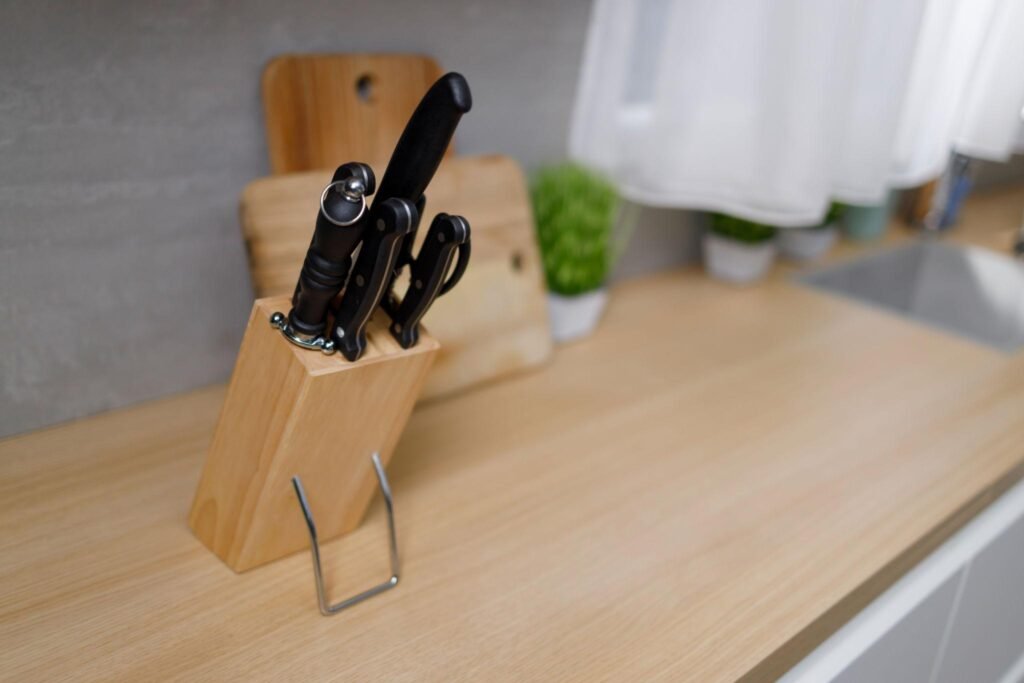
This is the one most people grew up with — a solid block of wood or bamboo with slots cut for different blade sizes. It sits on the counter, knives go in handle-up, and it looks tidy as long as your knives actually match the slots.
Best for: Kitchens with standard counter space and a knife set that came as a matched collection (the kind that’s specifically designed to fit the block).
The catch is that a traditional slotted block is only as good as the fit. If you’ve ever bought a new chef’s knife with a slightly thicker spine and tried to jam it into a slot that was sized for your old one, you know the frustration. It either doesn’t fit at all, or it fits so loosely that the blade rattles every time you walk past.
Magnetic Strip
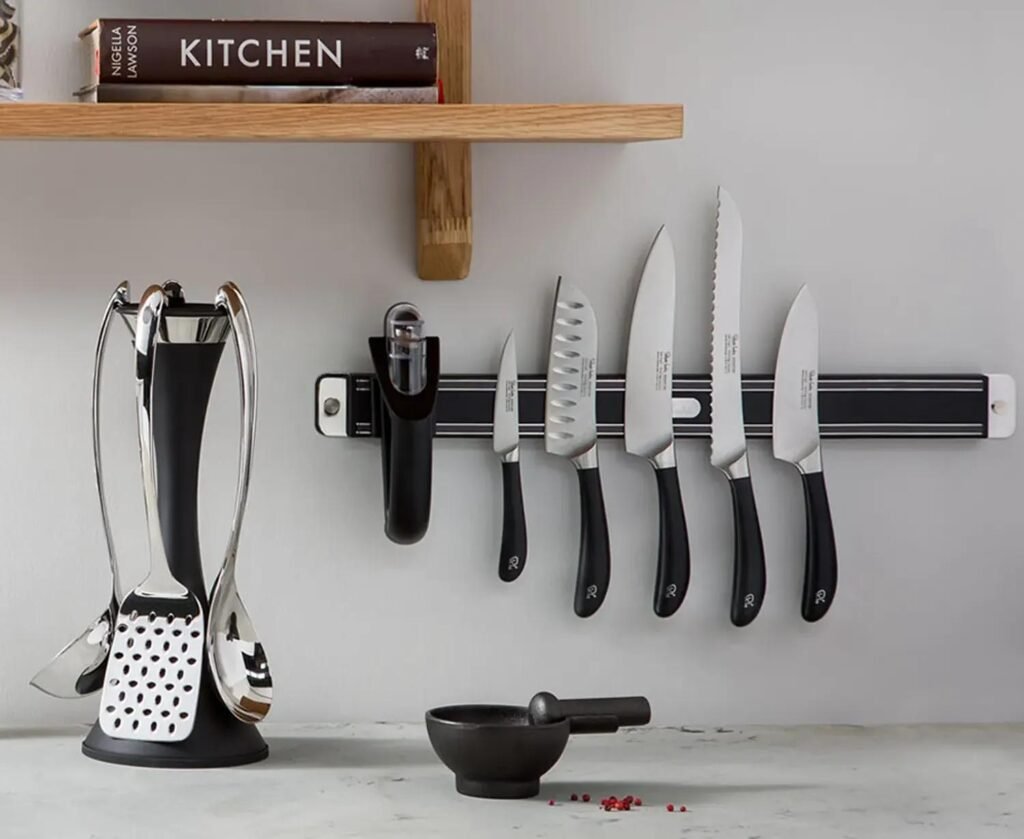
A magnetic strip mounts to your wall (or the side of a cabinet, or a backsplash) and holds knives by their blade or spine using strong magnets embedded in a wood, bamboo, or stainless steel bar. Knives sit out in the open, blade visible, which some people love for the look and others find a little unsettling with kids around.
Best for: Smaller kitchens with no spare counter space but some open wall real estate, and people who like the “chef’s kitchen” aesthetic of knives on display.
One thing nobody tells you until you’ve installed one yourself: mounting it properly matters a lot more than the marketing photos suggest. If you’re drilling into drywall without hitting a stud, you’re relying entirely on the anchors to hold the combined weight of your knives — and a loaded magnetic strip with six or seven knives is heavier than it looks. On tile, you’ll want a strip with a flush mounting plate and the right masonry anchors, or it’ll eventually pull loose. Done right, though, a magnetic strip holds knives more securely than most people expect, even heavier cleavers and chef’s knives.
In-Drawer Knife Organizer
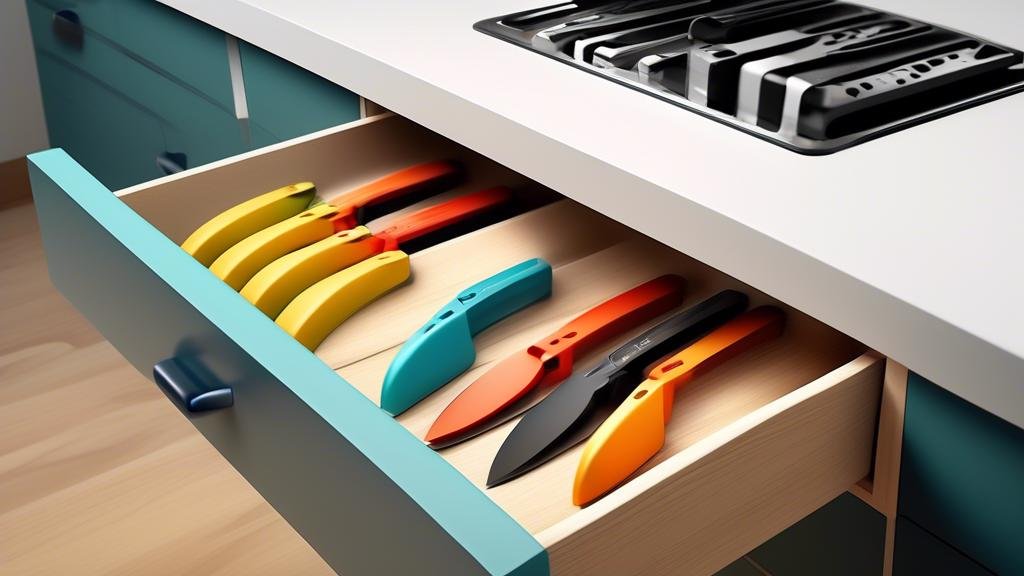
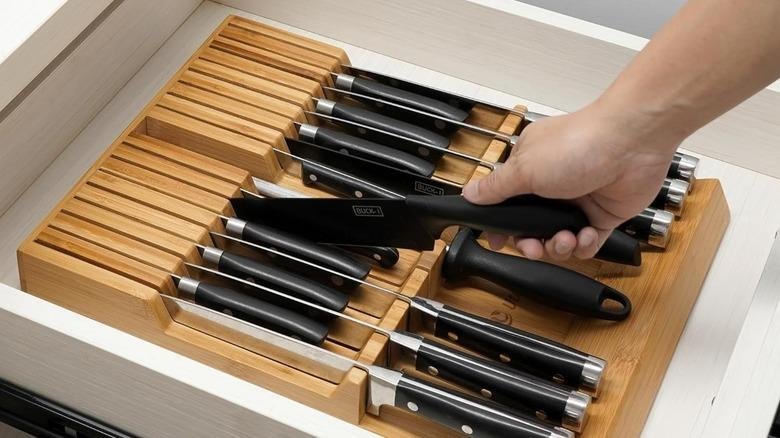
This is exactly what it sounds like — a tray or insert that sits inside a drawer, with slots or a felt-lined groove system to keep knives separated and stationary. Everything stays out of sight, which a lot of people prefer for both looks and safety.
Best for: Households with kids, anyone who doesn’t love the look of knives on display, and kitchens where counter space is tight but there’s a spare drawer to dedicate.
The main thing to check before buying is drawer depth. Most in-drawer organizers need at least 2 inches of depth to sit flat without the drawer sticking, and you’ll want to measure the drawer’s usable width too — not just the opening, since drawer slides and dividers eat into that space.
Universal or Slotless Holder
These use flexible bristles, rods, or a gel-insert system instead of fixed slots, so knives of pretty much any size and shape can be slid in. This solves the classic problem of owning a knife set that was assembled piece by piece over the years rather than bought as a matching block set.
Best for: Mixed knife collections — if you’ve got a cleaver, a couple of Japanese-style knives, kitchen scissors, and a sharpening rod that none of your old blocks ever had room for, this is the category that actually accommodates all of it.
Knife Block vs. Magnetic Strip: Which Is Actually Better?
This is probably the comparison people search for most, and honestly, the answer depends less on which is “better” and more on what you’re solving for.
A knife block protects blades inside enclosed slots, keeps knives completely out of reach if it’s placed high enough, and needs zero installation — you set it down and you’re done. The trade-off is counter space, and the fit issue if your knives don’t match the block’s slot sizes.
A magnetic strip frees up your counter entirely and actually does a better job than people expect at protecting blade edges, since the blade isn’t touching anything but air and the magnetic surface. But it does put knives in plain view and within easy reach, which matters a lot if there are kids in the house.
Quick answer: if counter space is your main constraint and you’ve got wall space to spare, go magnetic. If you’d rather keep knives fully enclosed and out of sight — especially with kids around — a block or in-drawer organizer wins.
Are Magnetic Knife Strips Safe?
Yes, generally — as long as two things are true. First, the strip needs to be mounted securely (into a stud, or with proper anchors rated for the weight), because a knife strip that comes loose is genuinely dangerous. Second, it needs to be placed somewhere kids can’t easily reach, since the whole appeal of a magnetic strip — knives visible and grabbable in one motion — is also its biggest safety consideration in a house with young children.
Keeping Knives Safe Around Kids
This is the part most knife storage guides skip entirely, and it’s arguably the most important section for a lot of households.
If you’ve got kids — especially curious toddlers or kids who are tall enough to reach counters but not old enough to understand why a knife is dangerous — an open magnetic strip at counter height is probably not your best option, no matter how nice it looks. Same goes for a countertop block sitting at the edge of the counter where little hands can reach.
The safer setups, in order of how much they help:
- In-drawer organizer with a child-proof drawer lock — this is the combination that actually solves the problem, rather than just hiding it
- Countertop block placed toward the back of the counter, against the wall, ideally on a higher counter section if your kitchen has one
- Magnetic strip mounted higher up, such as under an upper cabinet rather than at eye level on an open wall — knives stay accessible to adults but well out of reach for kids
If you’re rethinking your kitchen setup with kids in mind more broadly, it’s worth looking at childproofing your kitchen room by room — knife storage is one piece of a bigger picture that includes cabinet locks, oven controls, and cleaning product storage too.
Materials: Wood, Bamboo, Plastic, or Metal?
This is where a lot of buying guides get vague — “it depends on the material” — without actually explaining what that means in practice. Here’s the real breakdown.
Bamboo is the most common material for both blocks and magnetic strips because it’s durable, looks good, and is naturally somewhat resistant to bacteria. The catch: bamboo needs to dry completely before knives go back in. If you wash a knife and slide it back into a bamboo block while it’s still wet, moisture gets trapped in the slot. Do that repeatedly and you’ll start noticing a faint mildew smell within a few weeks — not a huge deal, but annoying, and avoidable just by letting blades air-dry for a few minutes first.
Solid wood (often acacia or walnut for nicer blocks) behaves similarly to bamboo but tends to be a bit more forgiving of moisture and generally holds up well for years if you’re not soaking it.
Plastic is the budget option and works fine for in-drawer organizers, since plastic trays handle moisture without warping. It’s less common for countertop blocks because it doesn’t have the same look or weight, but for hidden, in-drawer storage it’s genuinely a practical choice.
Stainless steel shows up mostly in magnetic strips and some universal holders. It’s the most durable option long-term and the easiest to clean, though it can show fingerprints and water spots more visibly than wood or bamboo.
If sanitation is a real concern for you — and it’s a fair thing to think about, since knife storage does collect moisture and food residue over time — look for blocks or organizers with EPA-certified antimicrobial materials. This isn’t marketing fluff; it genuinely reduces bacterial growth on the storage surface itself, though it’s not a substitute for occasionally wiping the holder down.
How Storage Affects Your Knife’s Edge
Here’s the angle that almost never gets mentioned, and it’s probably the most practical reason to upgrade from “knives loose in a drawer” to literally any of the options above.
When knives sit loose in a drawer, the blades knock against each other, against the drawer sides, and against other utensils every time the drawer opens and closes. Over weeks and months, this dulls the edge — not dramatically, but noticeably, and it’s part of why people end up sharpening their knives more often than they should need to.
Wood and bamboo blocks, magnetic strips, and properly designed in-drawer organizers all keep the blade isolated, with nothing touching the cutting edge itself. That alone extends the time between sharpenings. It’s a small thing, but if you’ve ever wondered why a knife that used to hold an edge for months now seems to need honing every week or two, drawer storage is very often the answer.
If you’re working on knife maintenance more broadly — keeping edges sharp between full sharpenings, using a honing steel correctly — that’s worth its own deep dive, but the short version is: better storage is step one, and it’s free once you’ve made the switch.
A Quick Word on Serrated Knives and Oversized Blades
One more thing that trips people up: not every knife fits neatly into a slot, magnetic line-up, or drawer tray. Bread knives with long serrated edges, cleavers, and oversized chef’s knives often don’t match standard block slots — this is exactly where a universal or slotless holder earns its place. If your collection has even one or two “doesn’t fit anywhere” knives, it’s worth building your storage solution around the universal style rather than forcing a mismatched block to work.
FAQ
What’s the difference between a knife block and a magnetic strip?
A knife block holds knives in enclosed slots on your counter, keeping blades fully covered and out of sight. A magnetic strip mounts on a wall and holds knives by magnetic force with the blade exposed — it saves counter space but keeps knives visible and within reach.
Do magnetic knife strips dull blades?
No — if anything, they’re gentler on edges than loose drawer storage, since the blade isn’t knocking against anything. The only wear comes from repeatedly sliding the same spot on the blade across the magnet, which is negligible over normal use.
Universal knife block vs. slotted knife block — which should I get?
Go universal if your knife collection is mixed or includes oversized pieces that don’t match standard slot sizes. Go slotted only if your knives came as a matched set specifically designed for that block.
How do I clean a wooden or bamboo knife block?
Wipe the exterior with a damp cloth and mild soap, then dry it fully. For the slots themselves, turn the block upside down occasionally and tap out crumbs, and let it air out in a dry spot every few months to prevent any trapped moisture buildup.
Are knife blocks sanitary?
They can be, with basic upkeep — letting knives dry before storing them and wiping the block down periodically. Blocks made with EPA-certified antimicrobial materials add an extra layer of protection, but they don’t replace basic cleaning habits.
What’s the safest place to store knives with kids around?
An in-drawer organizer paired with a child-proof drawer lock is the most reliable option. If you prefer a block or magnetic strip, position it toward the back of the counter or mount it higher up, out of a child’s reach.