Estimated reading time: 10 minutes
Last updated on June 10th, 2026 at 06:52 am
This one’s almost universal, so if it’s yours, you’re in good company. The most common version is a single ceiling fitting — either a bare bulb or one of those flush fittings that throws a flat, slightly harsh light over everything.
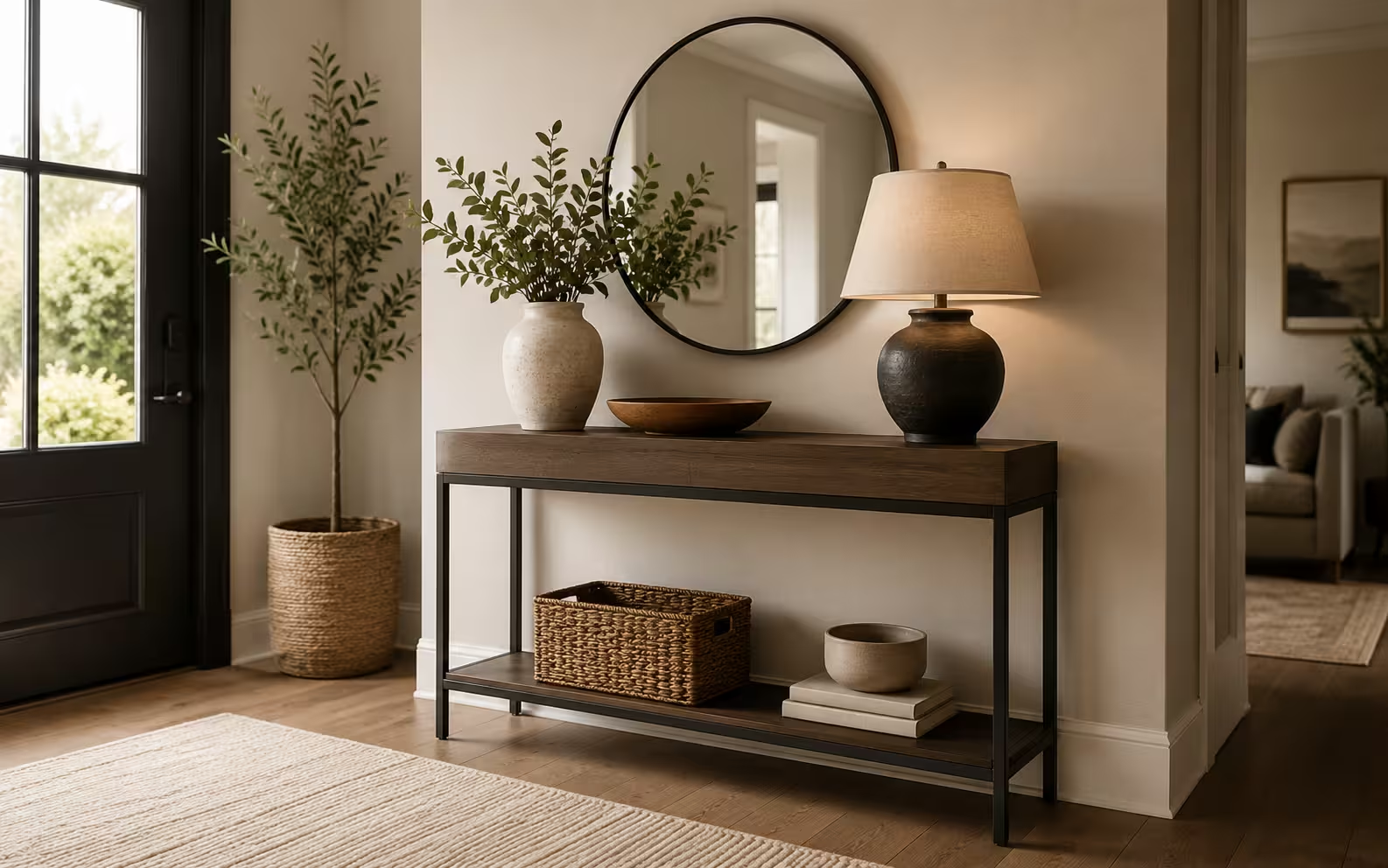
The problem isn’t brightness, it’s dimension. One light source from above casts shadows downward and makes a space feel flat and a bit clinical — like a waiting room. Layered lighting, on the other hand, creates depth. A wall sconce or a small lamp on a console table adds a warmer, lower light source that changes the whole feel of the room without any major work.
If you’re renting and can’t hardwire anything, a plug-in wall sconce or a table lamp does the same job. Even a battery-powered sconce on either side of a mirror is enough to shift the atmosphere. More on this in our hallway lighting ideas guide.
- 2. No system for the daily clutter
- 1. Relying on a single overhead light
- 3. Furniture that's the wrong scale
- 4. Ignoring the walls entirely
- 5. A rug that's too small
- 6. All function, no personality
- 7. All style, no function
- 8. A mirror hung at the wrong height
- 9. Skipping textiles altogether
- 10. Treating the entryway as an afterthought
2. No system for the daily clutter
Keys on the floor, bags draped over the bannister, shThe entryway is usually the last room people think about when decorating. It’s not where you spend time, it’s not where guests linger, and it’s easy to tell yourself it doesn’t really count. So it gets whatever’s left over — a coat hook here, a bare bulb there — and somehow it never quite comes together.
Here’s the thing: it’s the first room every guest actually sees. And while most people can’t articulate what’s wrong with a hallway, they feel it the moment they walk in. Designers, on the other hand, can usually name exactly what’s off within about three seconds. These are the ten things they notice most — and none of them require a renovation to fix.
The 10 Entryway Mistakes That Give Hallways Away
1. Relying on a single overhead light
oes scattered near the door. This isn’t a style problem — it’s a storage problem. When things don’t have a designated home, they make their own, and it’s never where you’d choose.
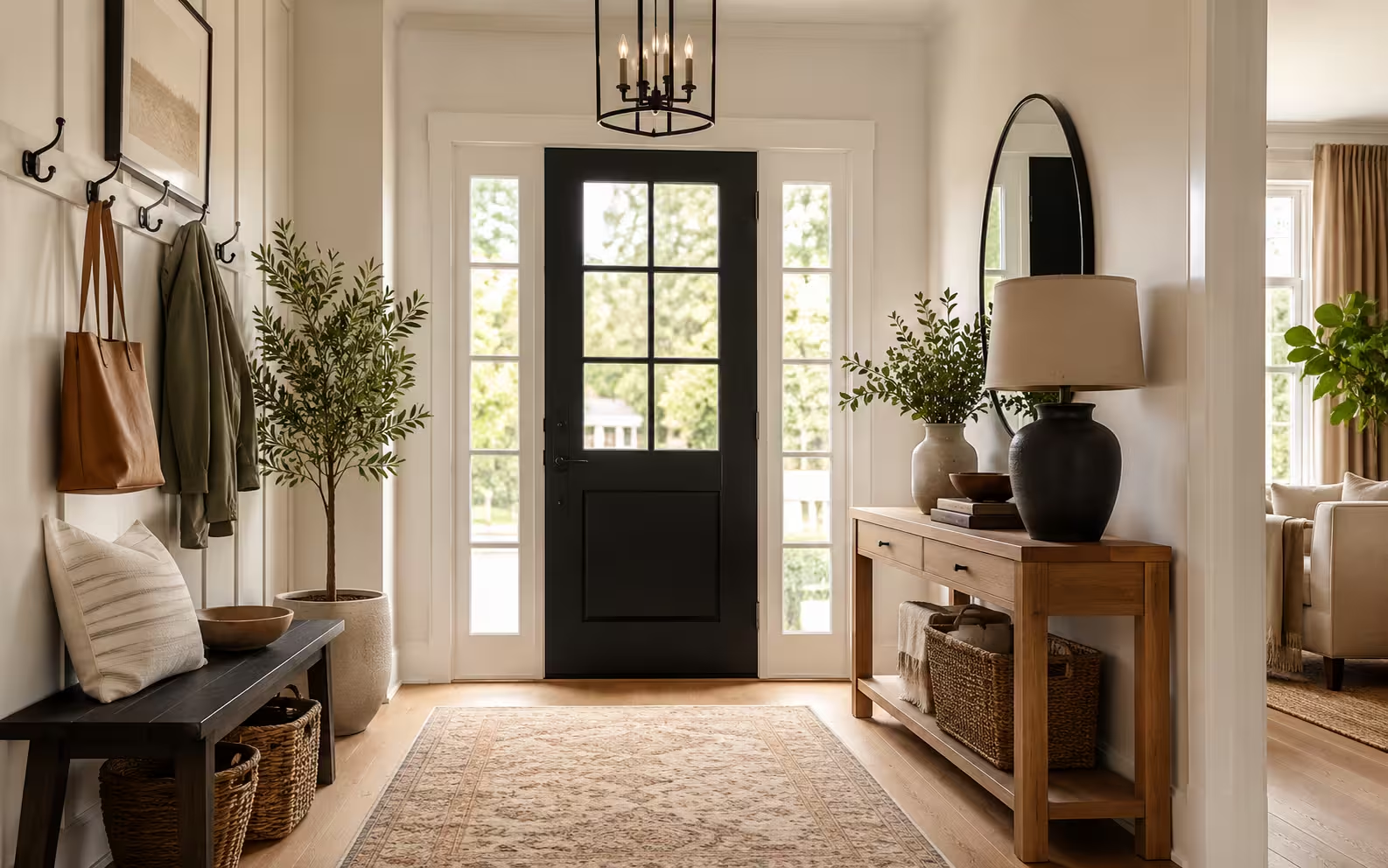
The fix isn’t tidying more often. It’s giving everything a place so tidying takes five seconds rather than five minutes. A small tray or dish for keys and change, hooks at varying heights for bags and coats, a low bench or basket for shoes. The specific items matter less than having a system at all.
A bench with storage underneath is probably the single most useful thing you can add to an entryway — it holds shoes out of sight, provides a seat for putting them on, and gives the space a sense of intention. See our entryway bench styling ideas for options at different sizes and price points.
3. Furniture that’s the wrong scale
Scale mismatch is one of those things that’s hard to name but immediately visible. A tiny console table in a wide foyer looks like it got lost. An oversized coat rack crammed into a narrow corridor makes the whole thing feel claustrophobic.
The principle behind this is visual weight — every piece of furniture carries a certain visual mass, and when that mass doesn’t match the space, something feels off even if you can’t say why. In a larger entryway, you need furniture with enough presence to fill the room without making it feel crowded. In a narrow hallway, slim-profile pieces (a legless floating console, a narrow bench) keep the space feeling open.
For small spaces specifically, our small entryway storage hacks covers what actually fits and what tends to overwhelm.
4. Ignoring the walls entirely
A hallway with bare walls and nothing else feels unfinished, even if the furniture is good. Walls are free real estate and most entryways leave them almost completely unused.
You don’t need a gallery wall with forty frames to fix this. A single large mirror, two wall-mounted hooks with a shelf between them, or three prints in a simple arrangement — any of these shifts the space from bare corridor to intentional room. The wall above a staircase is especially valuable and almost always gets ignored.
One caveat: if you’re going with a gallery wall, proportion matters. A cluster of small frames on a large wall looks timid and slightly chaotic. Bigger frames, or mixing in a few larger pieces, keeps the arrangement from looking like an afterthought.
5. A rug that’s too small
Probably the most common mistake in any room, not just entryways. A rug that’s too small for the space doesn’t anchor anything — it just floats in the middle of the floor looking slightly lost, and the room feels ungrounded as a result.
In an entryway, the rug should extend past the main furniture pieces — beyond the front legs of a bench, beyond the edges of a console table. If it doesn’t, it tends to make the furniture look like it’s hovering rather than belonging there. A larger rug also does more practical work: it catches more dirt from shoes and defines the space more clearly.
If you’re not sure what size to go with, err bigger than your instinct. Most people underestimate rug size every single time.
6. All function, no personality
A purely functional entryway — hooks, a rack, nothing else — isn’t necessarily a mistake. In a very minimal home it can feel intentional and clean. But in most homes, it just reads as unfinished.
The entryway is usually where guests form their first impression of your home and your taste. That doesn’t mean it needs to be styled like a magazine shoot. But one or two things that feel personal — a plant, a print you actually like, a small object on a shelf — give the space character. It takes less than you’d think. For ideas on getting the balance right, our modern entryway decor ideas guide covers this well.
7. All style, no function
The opposite problem, and arguably more frustrating to live with. A beautiful entryway that has nowhere to put your coat, no surface for your keys, and no seat for your shoes is going to be covered in clutter within a week regardless of how good it looked on day one.
Style and storage aren’t mutually exclusive — a well-chosen bench, a set of wall hooks, and a slim console can all be genuinely nice looking. The mistake is prioritising how things photograph over how the space actually gets used every day.
8. A mirror hung at the wrong height
Mirrors are one of the most useful things you can put in a hallway — they reflect light, make the space feel larger, and serve a practical purpose on the way out the door. But where you hang them matters almost as much as having one at all.
The most common error is hanging the mirror too high. The centre of the mirror should sit roughly at eye level (around 150–160cm from the floor for most people), which means the practical reflective zone is at a useful height. Too high and you’re looking at your forehead. Too close to the ceiling and it stops reading as a mirror and starts reading as art — which is fine if that’s the intention, but not if you want it to do any of the useful things mirrors do.
For help choosing the right size and style, our best mirrors for entryways guide goes through the key decisions.
9. Skipping textiles altogether
Textiles — rugs, cushions on a bench, an upholstered seat — are what make spaces feel lived-in rather than staged. An entryway with only hard surfaces (tile, wood, painted walls, metal hooks) tends to feel cold and slightly impersonal, regardless of how well everything else is done.
A rug is the most important textile in an entryway, and also the easiest to add. Even a simple flatweave does the job. If your bench has a seat, a cushion adds comfort and visual softness. If there’s an accent chair, a throw over the arm changes the temperature of the whole space. None of this needs to be expensive to be effective.
10. Treating the entryway as an afterthought
Not “not decorating” — that’s too vague to be useful. The real version of this mistake is making all the decisions for the entryway last, with whatever budget and energy is left over, and then wondering why it doesn’t match the rest of the house.
Hallways often end up with mismatched furniture that was left over from other rooms, a rug that was rejected from the living room, and lighting that nobody particularly chose. It looks exactly like what it is — a collection of leftovers. Giving the entryway its own brief, even a simple one (two to three pieces that work together, a consistent colour, one statement element), makes an enormous difference to how cohesive it feels.
If You Only Have Time to Fix One or Two Things
Not everyone has a weekend to overhaul their entire hallway. If you’re prioritising, here’s where your effort will have the most visible impact:
Fix the lighting first. Nothing changes the feel of an entryway faster than adding a second light source. A wall sconce or a lamp on a console table takes an hour to install or style and the difference is immediately noticeable — especially in the evenings.
Sort the clutter system second. If your hallway gets messy within a day of tidying, adding storage is more effective than tidying more. Hooks, a key tray, and a shoe bench address the root cause rather than the symptom. For budget-friendly ways to do this, our budget entryway makeover ideas has options from under £30.
Add a rug if there isn’t one. It’s the fastest way to make a bare floor feel intentional and the single most impactful soft furnishing in an entryway. Go bigger than you think you need.
Frequently Asked Questions
Usually a combination of scale mismatches, a single harsh overhead light, and no soft furnishings. A too-small rug is one of the most common culprits — it makes everything look slightly off-proportion. Good lighting and a properly sized rug fix most of the problem without spending much.
Oversized furniture in a narrow space, a rug that’s too small for the floor area, and anything that creates clutter without serving a function. Avoid furniture with nowhere to actually put daily items — it’ll be covered in bags and coats within days regardless of how it looks.
Almost always because it’s relying on one overhead light source. Hallways rarely have windows, so lighting does all the work. Adding a lower light source — a wall sconce, a plug-in lamp, even LED strip lighting under a console — layers the light and makes the space feel warmer and more dimensional.
They start with function — storage for coats, shoes, and keys — then layer in style. A mirror to reflect light, a rug to anchor the space, layered lighting, and one or two personal touches (a plant, a print) are the core components. The goal is a space that works every day and feels good when guests arrive.
Proportionally, yes — maybe more than in a large space. Small hallways feel the effects of clutter, bad lighting, and scale mismatch more acutely because there’s less room for anything to hide. The good news is the fixes are also simpler: wall-mounted storage instead of freestanding, a mirror to add depth, and keeping the floor clear make a significant difference in even the smallest corridor.