Estimated reading time: 11 minutes
Last updated on June 23rd, 2026 at 05:48 am
You open the cabinet to grab a pan and three others come crashing out. Or you’re pretty sure the canned tomatoes are in there somewhere — behind the mystery cans you’ve been moving from shelf to shelf for two years. Sound familiar?
Kitchen cabinet organization ideas are everywhere online, but most of them are either blindingly obvious (“use labels!”) or just a product dump with no real reasoning behind it. This is the stuff that’s actually made a difference — specific products, honest caveats, and the logic behind why each one works. No vague decluttering pep talks.
Before You Order Anything — Do This First
Measure your cabinets. Seriously. It sounds obvious, but it’s the reason so many organizers end up being returned.
Before buying any cabinet insert, rack, or bin, you need three numbers: the interior width of the cabinet opening, the depth of the shelf, and the height clearance between shelves. Write them down. Keep them on your phone when you’re shopping.
A turntable that’s two inches too wide won’t spin. A pan rack that’s slightly too tall will keep the shelf above it from closing properly. Checking dimensions first takes two minutes and saves a lot of frustration.
Also worth noting: if you’re renting or just don’t want permanent modifications, stick to freestanding organizers and Command-strip solutions. Several of the ideas below work perfectly without a single screw.
Ideas for Storing Cans, Jars, and Dry Goods
A can rack makes a surprising amount of space appear
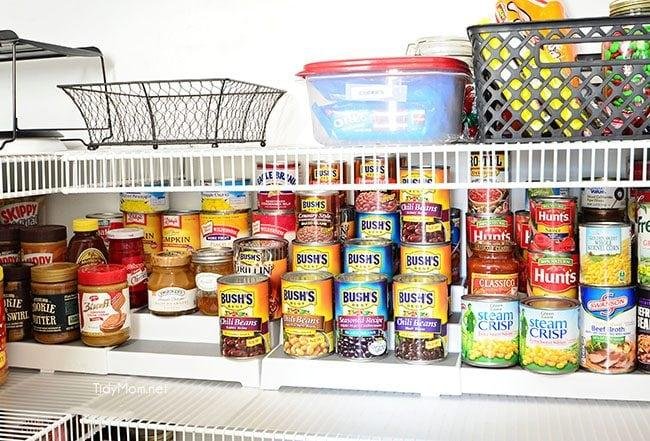
The back of a pantry shelf is a graveyard for canned goods. A can rack organizer — the kind that lets cans roll forward as you use them — fixes this almost completely. You load from the back, grab from the front, and you can actually see everything you have without pulling half the shelf out.
This works especially well in a cabinet above a pantry or in deeper shelves where things tend to disappear. If your shelf is shallow, a tiered riser that elevates each row is a simpler alternative — every can is visible at a glance instead of hidden behind the row in front.
Turntables are underrated (but size matters more than people think)
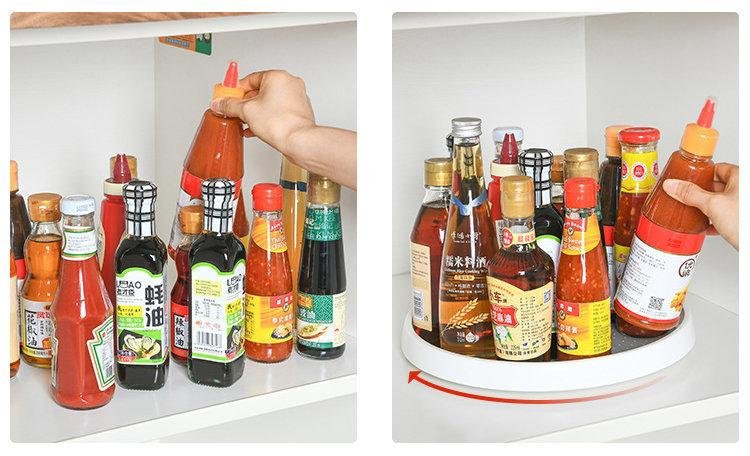
A spinning turntable — sometimes called a lazy Susan — sounds almost too simple to be worth mentioning. But the specific reason most people don’t get much out of them is that they buy one that’s too small for the shelf.
The trick is to choose a turntable that’s close to the full depth of the shelf it’s sitting on. A 10-inch turntable on a 15-inch deep shelf means items at the back still get buried. A 14-inch turntable on that same shelf means everything rotates into reach. We use one for oils, vinegars, and sauces, and it’s genuinely one of the most-used things in our pantry.
If you have extra cabinet height, a double-decker turntable doubles your storage without using any additional shelf space.
What didn’t work: the spinning spice organizer
One product that looked great but didn’t deliver — a multi-tier spinning spice organizer. The design was clever, the reviews were solid, but in practice the top shelf wasn’t sturdy, the whole thing didn’t spin smoothly, and the lip on our cabinet shelf stopped it from rotating properly anyway. Ended up going back to a basic turntable and a small tiered riser for spices instead. Sometimes simpler is more reliable.
Solutions for Pots, Pans, and Baking Sheets
Stop stacking pans — get a vertical rack instead
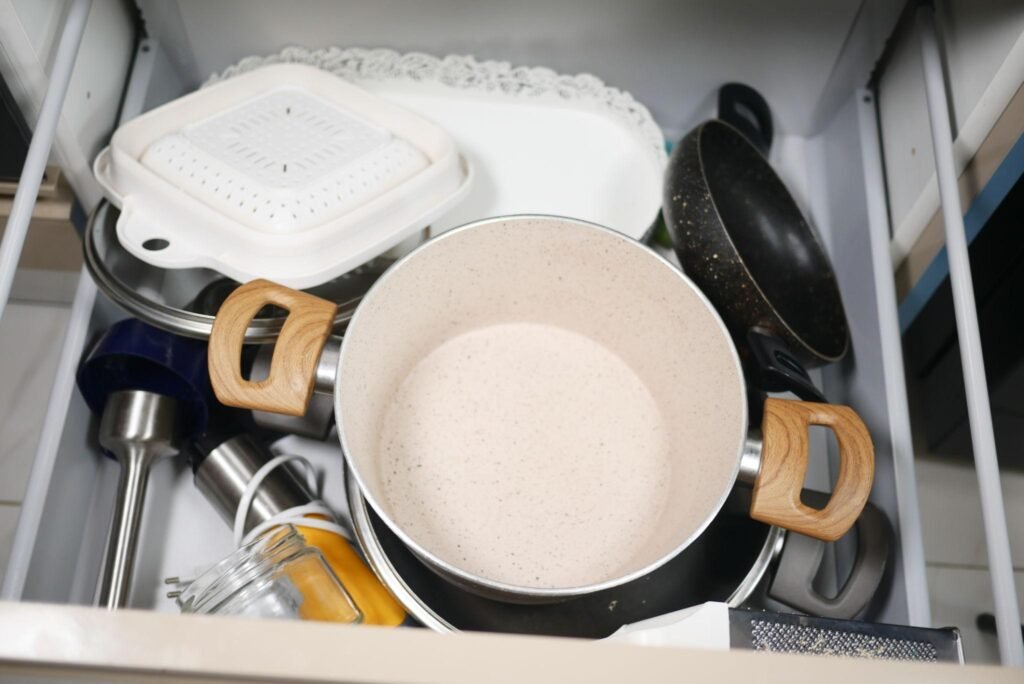
If you store pans in a base cabinet, you’re probably doing one of two things: stacking them (which means lifting four pans every time you want the one at the bottom) or leaning them against each other (which means a minor avalanche every time you open the door).
A pan organizer rack solves this by giving each pan its own vertical slot. You pull out exactly the one you need. No reshuffling, no balancing act. These racks can sit either vertically or horizontally in the cabinet depending on what configuration gives you more room — worth testing both before committing to one position.
Baking sheet dividers for the deep cabinet disaster
The cabinet where baking sheets, cutting boards, and cooling racks live is one of the most chaotic in most kitchens. Metal dividers that attach to the top and back of the cabinet interior are a clean fix — you can choose your own spacing and install them yourself with just a couple of small screws.
They come in 12-inch and 18-inch heights, so check your clearance before ordering. The taller version is worth getting if you have the room — it keeps everything more stable. If you’d rather not drill anything, a freestanding rack (similar to a file organizer, scaled up) does the same job and works just as well.
Under-shelf baskets for the dead space you’re ignoring
Most cabinet shelves have 6 to 10 inches of unused air above the items stored on them. An under-shelf basket clips onto the shelf above and hangs down into that space, creating an extra storage tier for things like aluminum foil, plastic wrap, parchment paper, napkins, or coffee pods.
One caveat: these baskets aren’t built for anything heavy. Dishes and cans will bow the shelf they’re clipped to. Keep them for lightweight, flat items and they work perfectly.
Taming Food Storage Containers and Water Bottles
Separate the lids from the containers
Food storage containers are a specific kind of kitchen chaos. The lids and containers nest differently, stack at different heights, and never seem to stay matched up. The solution that actually works: store the containers stacked on one shelf and keep the lids upright in a dedicated lid organizer on another shelf or in a drawer nearby.
A lid organizer — basically a narrow rack that holds lids vertically — makes it easy to see and grab exactly the lid you need without pulling out a dozen others. It takes about ten seconds to find what you need instead of the thirty-second lid hunt that derails every meal prep session.
Worth switching to glass containers if you haven’t already. They stack more reliably than plastic, they don’t warp in the dishwasher or microwave, and they hold their shape over time, which means the lids still fit properly years later.
The magazine rack trick for water bottles
If you have a collection of reusable water bottles taking up cabinet space, try this: take a magazine rack (or a stackable file organizer), lay it on its back, and use it to store bottles horizontally. Each bottle has its own slot, you can see them all at once, and grabbing the one you want doesn’t mean shuffling through a cluster of standing bottles to find it.
It’s not a product designed for this purpose, and somehow that’s exactly why it works so well.
Under-Sink and Base Cabinet Organization
Deep cabinet solutions when you can’t change the plumbing
The area under the kitchen sink is its own challenge. There’s a drainpipe running through the middle of it, possibly a garbage disposal taking up one side, and it’s usually darker and harder to access than any other cabinet in the kitchen.
A two-tier wire drawer organizer — the kind with a moveable divider inside each drawer — fits well in the long, narrow space that a lot of under-sink cabinets have. The moveable divider keeps things from sliding around whether the drawer is half-empty or packed. It’s also a good spot for dish towels if drawer space elsewhere is limited.
For smaller items like dishwasher tablets, a glass canister or jar keeps them contained, visible, and easy to grab. A beverage can organizer repurposed for sponges, brushes, and scrubbers works well too — the flat-lipped top gives you a useful surface to rest things on.
Pull-out trash bins are worth the one-time effort
Adding a pull-out trash bin to a base cabinet is one of those upgrades that feels disproportionately satisfying. You need a cabinet opening that’s at least 15 inches wide. If you have that, a retrofit pull-out waste container that mounts to the inside of the cabinet door works exactly like the built-in version in newer kitchens — the door opens and the bins come with it.
It takes an hour to install, requires a screwdriver and a drill, and is not a rental-friendly modification. But if you own your home and currently have a bin sitting on the kitchen floor, it’s absolutely worth the effort.
Cord organizers for small appliances
When you’re storing a stand mixer, blender, or slow cooker in a cabinet, the cord is always the annoying part — it catches on things, gets tangled, and makes the appliance harder to put away cleanly. Stick-on cord wraps that attach directly to the appliance body solve this neatly. The cord wraps around the clips, the appliance goes in the cabinet without dragging anything with it.
Not all cord organizers stick reliably — the adhesive on cheaper versions tends to fail after a few months. Choose a brand known for strong, lasting adhesive and test it on one appliance before buying a full set.
The Cabinet Door Backs Most People Completely Ignore
The inside of a cabinet door is free storage space. Most kitchens don’t use it at all.
Spray bottle hangers mounted with removable Command strips are one of the most practical additions you can make to the back of a base cabinet door. Your most-used cleaning sprays hang right there, easy to grab, completely out of sight when the door is closed. No countertop clutter, no digging under the sink.
Command spring clips on the back of upper cabinet doors work well for the things that usually end up stuck to the fridge — current recipes, grocery lists, coupons, notes. They hold paper securely, they’re repositionable, and they don’t leave marks when you eventually remove them. Rental-friendly, zero tools required.
If you keep aluminum foil, plastic wrap, or parchment paper in a cabinet rather than a drawer, a mounted dispenser holder on the back of a cabinet door is worth considering too. It keeps the boxes from rattling around and means you can tear a sheet with one hand instead of chasing the box across the shelf.
FAQs
How do you organize deep kitchen cabinets so things don’t get lost at the back?
The most effective approach is to use either a turntable (lazy Susan) that fills most of the shelf depth, or pull-out organizers that bring items forward. Tiered risers and can racks also help by making the back rows visible. The key is choosing products sized to the actual depth of your shelf — a small organizer in a deep cabinet just creates more dead space behind it.
What’s the best way to store pots and pans in a cabinet?
A vertical pan organizer rack that gives each pan its own slot is the most practical solution. It eliminates the need to stack and shuffle, and you can pull out exactly the pan you need in one move. These racks can be oriented vertically or horizontally depending on cabinet dimensions.
How do I organize the cabinet under the kitchen sink?
Work around the plumbing rather than against it. A two-tier wire drawer organizer fits well in the long narrow spaces most under-sink cabinets have. Canisters for tablets and a beverage organizer for scrubbers and brushes handle the smaller items. A pull-out trash bin is worth adding if the cabinet opening is at least 15 inches wide.
What can I put on the back of kitchen cabinet doors?
Spray bottle hangers (mounted with Command strips for a no-drill option), Command spring clips for paper notes and lists, and foil or wrap dispensers are all practical additions. The inside of a cabinet door is genuinely useful storage space that most kitchens leave completely empty.
How do I stop food storage lids from becoming a disorganized mess?
Store lids separately from containers using a vertical lid organizer — either a standalone rack or one mounted in a drawer or cabinet. Standing lids upright makes them visible and individually accessible instead of buried in a stack. Switching to glass containers also helps since they maintain their shape over time and the lids continue to fit properly.