Estimated reading time: 8 minutes
Nobody looks forward to cleaning their gutters. But leaving them blocked is genuinely one of the more costly home maintenance mistakes you can make — water backs up, fascia boards rot, and in bad cases, damp starts working its way into walls and foundations. So the question isn’t really whether to do it. It’s which tool makes it least miserable.
The good news: you don’t necessarily need a ladder. That’s the thing most buying guides gloss over, which is frustrating because ladder anxiety is the real reason most people are searching for this in the first place. Several tools are specifically designed for ground-level cleaning, and for a single-storey home, they work well.
Let’s get into it — grouped by cleaning method so you can find what actually suits your situation, rather than wading through a list of 20 products with no context.
The Best Gutter Cleaning Tools — Quick Overview
Before the detail, here’s the short version:
- Gutter scoop — cheap, effective, needs a ladder. Best for heavy compacted debris.
- Telescoping hose wand — extends to single-storey gutter height from the ground. Good for regular flush-throughs.
- Leaf blower gutter kit — fast for dry autumn leaves. Useless on wet sludge.
- Wet/dry vacuum extension kit — handles wet debris that a blower won’t shift. Messier to empty.
- Pressure washer gutter attachment — best for flushing blockages, including downspout clogs. Reaches 2nd-floor gutters on longer wands.
- Gutter exterior cleaner — spray or brush for the outside face of plastic guttering. A separate job entirely.
Gutter Cleaning Without a Ladder — The Tools That Actually Work
If heights aren’t your thing, or you’d simply rather not set up a ladder every time, this section is for you.
Telescoping gutter wands are the most versatile ground-level option. They’re essentially extension poles — usually 2–4 metres when extended — with a curved nozzle at the tip that hooks over the gutter edge. Connect it to your garden hose, turn it on, and water flushes debris toward the downspout. They take a bit of practice to angle correctly, especially around the downspout inlet, but once you’ve got the feel for it they’re straightforward. Expect to pay £20–60 for a decent one.
The main limitation is that you’re working blind — you can’t see into the gutter while you’re cleaning it, so thoroughness takes a few passes. They also struggle with compacted, wet debris. If it’s basically compost in there, a wand alone won’t shift it.
Leaf blower gutter kits are honestly one of the most satisfying tools if the timing is right. Right after autumn leaf fall, when debris is still dry and loose — a blower attachment kit clears a long run of gutter in a few minutes. The kit is just a set of curved tubes that direct airflow up and into the gutter channel. Most universal kits cost £15–30, and brand-matched versions (Ryobi, Stihl, Makita) are available for many popular blowers.
The catch is it only works on dry material. Try this on wet, decomposed leaves that have been sitting since November and you’ll barely shift anything. It also blows debris onto your garden and paths, so factor in a bit of tidying afterwards. And do check the forecast — cleaning gutters with a blower on a breezy day means half of it comes straight back at your face.
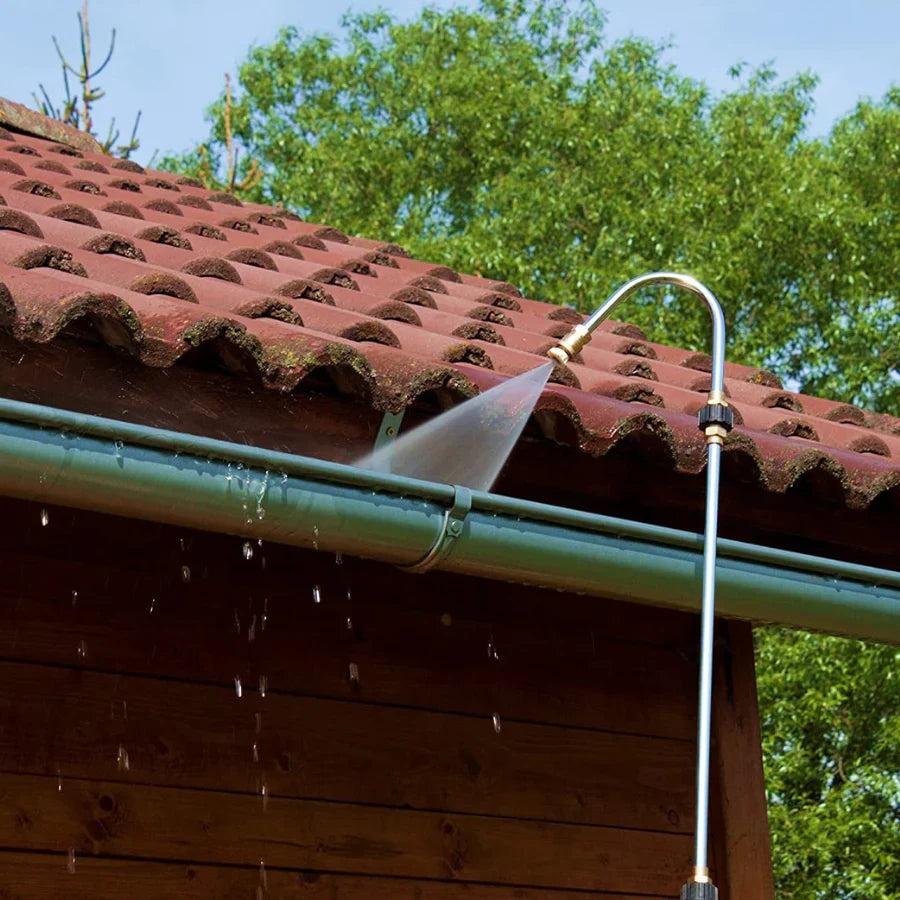
Pressure washer gutter attachments are the most powerful ground-level option, and the best choice if you’re dealing with a blocked downspout. The attachment is a U-shaped lance that clips onto your standard pressure washer wand, curves up over the gutter edge, and shoots water along the channel from below. The curved design means you can flush the full length of the gutter without any ladder — and if a downspout is blocked, the pressure usually forces the clog through and out the bottom.
One caveat: don’t go full pressure on old or ageing guttering. High-pressure water can work its way into loose end caps or aged sealant joints. Keep the lance moving, use a moderate setting, and you’ll be fine on anything reasonably well-maintained.
Manual Gutter Scooping — Still Worth Knowing About
There’s a reason the humble gutter scoop has been around forever. If you’re comfortable on a ladder and want the most thorough clean possible, nothing really beats it. You can see exactly what you’re doing, remove every bit of buildup by hand, and properly clear the downspout entry rather than hoping a wand has reached it.
Plastic gutter scoops are shaped to match standard gutter profiles (half-round or square-line), which means they pick up more per scoop than a general trowel. They cost £3–10 and last years. After scooping, follow up with a garden hose flush to check the downspout runs clear.
The obvious downside is ladder access every single time. If that’s a concern — for reasons of safety, confidence, or simply not wanting to get the ladder out twice a year — one of the ground-level methods above is the more practical long-term choice.
Wet/Dry Vacuum Kits — For When the Debris Is Already a Mess
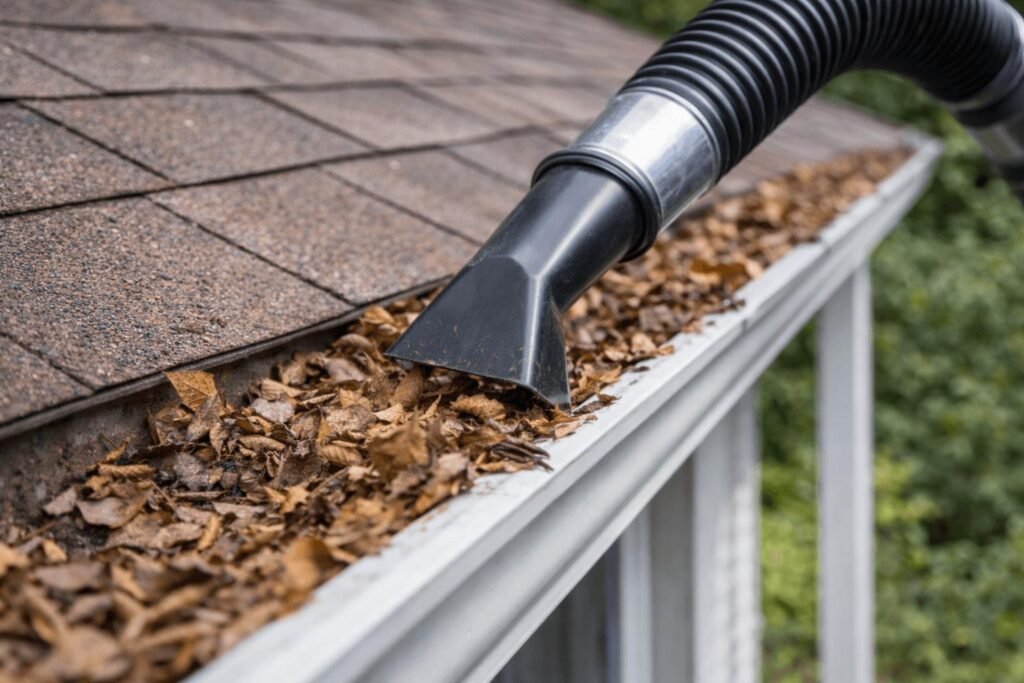
Spring cleaning is often a different beast to autumn. By the time March arrives, what was dry leaves in November is now a grey, wet, compacted mush. That stuff doesn’t blow out — it needs to be sucked or scooped.
Wet/dry vacuum extension kits are the ground-level answer to this. They’re tube sets — usually a mix of straight and curved sections — that attach to the inlet of a wet/dry vac and extend long enough to reach gutter height. Karcher, Vacmaster, and Numatic all make compatible kits for their own vacs; generic kits exist too, just check the inlet diameter (usually 32mm or 35mm) before buying.
In practice, they work well for debris that a blower would ignore. The downside is the mess when you empty the canister — decomposed leaf matter has a particular aroma that’s hard to describe charitably. Also, positioning the nozzle blind means you’ll need a few repositions to get the full run of the gutter. Not the quickest method, but one of the most thorough for wet conditions.
Cleaning the Outside of Your Gutters — A Separate Job

One section that’s almost never in gutter tool roundups: the outside face. Over time, plastic guttering develops green algae streaks, black oxidation marks from UV exposure, and general weathering discolouration. None of the interior cleaning tools touch this — they’re designed for the channel, not the face.
If your gutters look noticeably grubby on the outside, you want either a purpose-made exterior gutter cleaner spray (products like Gutter Brite or similar) or a long-handled exterior brush. Apply, scrub, rinse. It makes a real difference to how the front of the house looks, and it’s worth doing once a year alongside your interior clean rather than letting years of algae build up.
What to Spend — A Realistic Price Guide
Budget tools (£3–20) cover the basics: plastic scoops, simple blower nozzle kits, entry-level brushes. They work, but cheap extension poles can feel flimsy when extended full length.
Mid-range (£20–60) is the sweet spot for most homeowners. A decent telescoping hose wand, a good vacuum extension kit, or a pressure washer gutter lance — all available in this range, all built to last a few years of twice-annual use.
Higher-end (£60–120+) makes more sense if you have a large property, very high gutters, or you’re committed to doing this properly every season. Brand-matched kits from Kärcher, Ryobi, or Stihl tend to fit better and last longer than generic alternatives.
If You Already Own a Pressure Washer, Blower, or Wet Vac
It’s worth checking your existing tool’s accessory range before buying anything new. Most major brands have first-party gutter cleaning add-ons:
- Leaf blowers — check the brand’s accessory page for gutter kits. Universal kits (£15–25) fit most standard outlets.
- Pressure washers — Kärcher, Nilfisk, and Bosch make proprietary gutter lances. Third-party versions exist for M22 and quick-connect fittings too.
- Wet/dry vacuums — Karcher WD range, Numatic George, and most workshop vacs accept 32mm or 35mm extension kits.
The cost of an attachment is usually £15–50. That’s considerably cheaper than buying a standalone tool, and the performance is comparable.
How Often Should You Clean Your Gutters?
Twice a year is the right baseline — late autumn once the leaves have come down, and early spring to clear any winter buildup before heavy rain. If you have trees overhanging the roofline, you may need a third pass in summer when seed pods and small debris can accumulate faster than you’d expect.
A good habit is to check the downspouts specifically after any major storm — blocked downspouts are the number one cause of gutters overflowing, and clearing one usually takes five minutes if you catch it early. For more on year-round home upkeep, the monthly home maintenance checklist is a useful reference, and the seasonal maintenance before and after guide covers when to tackle each task through the year.
The tools are genuinely not expensive. Even a full kit — scoop, hose wand, and a blower attachment — costs less than one call-out from a professional gutter cleaning service. Get the right one for your situation and it’s a manageable twice-yearly job rather than the stressful, ladder-dependent task it used to be.