Estimated reading time: 11 minutes
Most dining rooms have at least one of these problems. A surprising number have several. And the frustrating part is that they’re almost always fixable once you know exactly what you’re looking at.
The dining room is one of those spaces that only really gets scrutinised when guests are sitting in it. By then it’s too late to do anything about it. Getting these dining room design mistakes sorted before that moment — before the dinner party, before the family gathering — is entirely worth the effort.
Here’s what’s actually going wrong, why it happens, and what to do instead.
- The Rug Mistake That Affects Almost Every Dining Room
- Proportion Problems: Table-to-Room and Chair-to-Table
- The Comfort Problem That Ends Dinners Early
- Lighting: Ambiance Isn't Optional
- The Matching Furniture Trap
- Wall and Window: The Details That Actually Finish a Room
- Why Flat, Uniform Rooms Feel Cold
- Small Dining Rooms — Specific Mistakes Compact Spaces Make
- The Table Finish Problem Nobody Talks About
- A Few Things Worth Knowing Before You Buy Anything
- Frequently Asked Questions
The Rug Mistake That Affects Almost Every Dining Room
This is the big one. Undersized rugs are the single most common dining room design mistake, and it’s easy to understand why it happens: people size the rug to the table footprint. The table is, say, 90cm wide — so they buy a rug that’s around 120–140cm wide and it looks fine in the shop.
Then the chairs get pulled out.
The rule is simple: every chair leg must remain on the rug when the chair is pulled back from the table. That means you need at least 60–75cm of rug extending beyond the table on each side — not just a few centimetres of visual border. For a standard rectangular dining table seating six, that usually means a rug of at least 200cm x 300cm, often larger.
A too-small rug doesn’t just look wrong. Chairs rock unevenly as they transition between rug and hard floor. Guests instinctively notice the sensation even if they can’t name it. It makes the whole dining area feel unsettled.
On pile height: keep it low. A deep shag rug in a dining room sounds appealing in theory, but chair legs sink, scraping becomes a constant irritant, and anything that drops between meals is essentially lost. Low-pile flatweave or a short-pile wool are far more practical. You can explore specific material options in this guide to the best rugs for dining rooms.
Worth knowing: if your space genuinely can’t fit a rug of the right size, going rug-less entirely is a cleaner choice than a rug that’s too small. A bare floor with a well-grounded furniture arrangement reads as intentional. A rug that gets half-covered by chairs reads as an afterthought.
Proportion Problems: Table-to-Room and Chair-to-Table
A dining table that’s too large for its room creates obvious problems — no one can get to their seat without turning sideways. But undersized tables in large dining rooms are quietly just as bad. The furniture floats. Nothing feels anchored.
The minimum clearance you need between the edge of the table (with chairs in) and the nearest wall or furniture is around 90cm. That’s enough to push a chair back, stand up, and move around without it feeling like an obstacle course. Drop below that and the room starts to feel cramped regardless of how it looks from the doorway.
Chair scale matters too. Dining chairs that are noticeably too small for the table look like they belong to a different set — because visually, they do. The seat height should bring diners to a comfortable eating position, typically around 45–48cm seat height for a standard 76cm dining table. It sounds like an obvious detail. It gets missed more than you’d think.
The Comfort Problem That Ends Dinners Early
People don’t linger at uncomfortable dining tables. Long meals, good conversations, evenings that extend naturally — all of that depends, more than anything else, on whether the chairs are actually comfortable to sit in for more than 45 minutes.
Hard wooden chairs with no back support empty out fast. Upholstered seats, padded dining chairs, or banquette seating in a corner arrangement invite people to stay. This isn’t about luxury — it’s about the basic function of a dining room.
If you’ve invested in a beautiful table and settled for uncomfortable chairs, the chairs are the problem. A mixed approach works well here: upholstered chairs at the sides with a simpler bench or wooden chairs at the ends, for instance. The seating drives the experience of the room far more than the table does.
Lighting: Ambiance Isn’t Optional
Harsh overhead lighting is one of the most reliable ways to make a dining room feel unwelcoming. And yet it’s incredibly common — because “there’s already a light fitting up there” is usually the end of the conversation.
Two things matter most in dining room lighting.
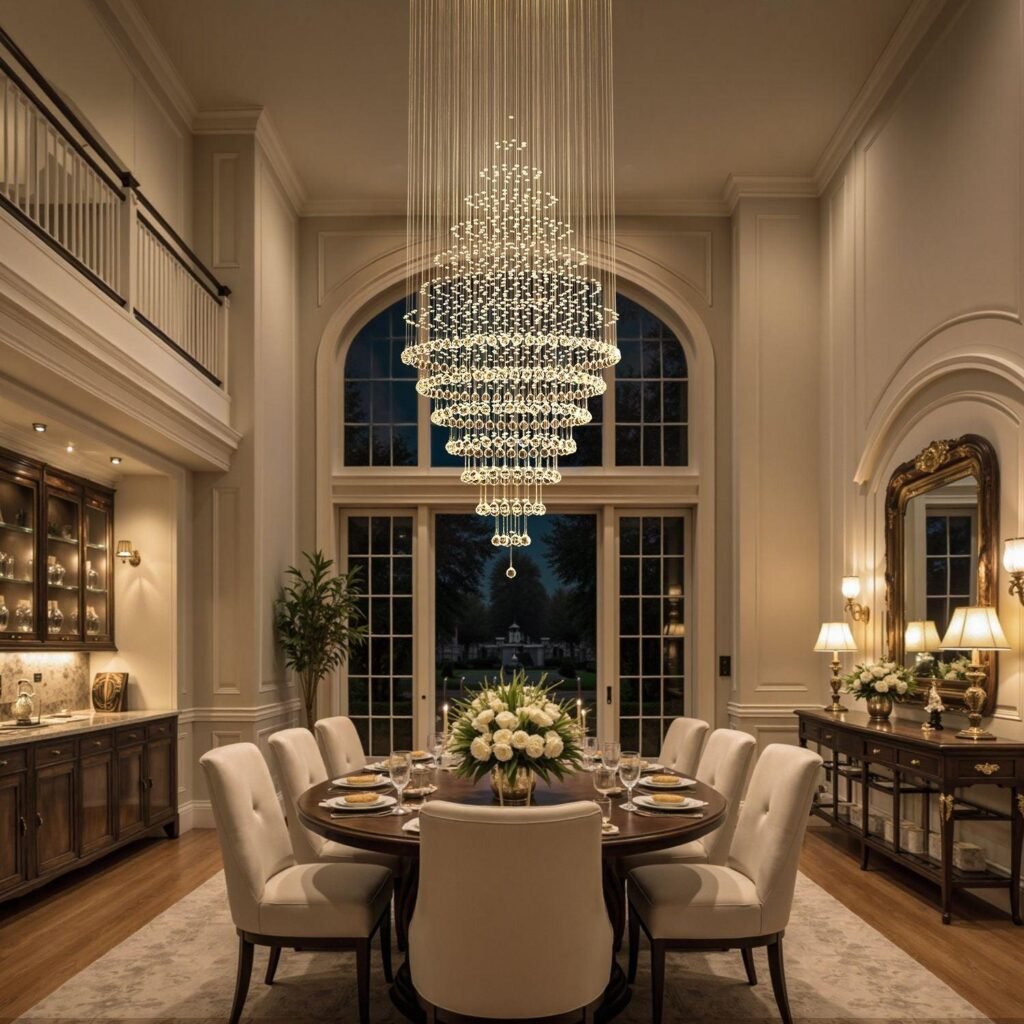
First: pendant height. The bottom of your chandelier or pendant should hang around 75–90cm above the tabletop. Dining rooms allow for lower hanging than other rooms because there’s no foot traffic passing underneath — the fixture hangs over a fixed piece of furniture. Getting this right means the light actually illuminates the table and the people at it, rather than washing out from ceiling height. If you’re shopping for a new fixture, this guide to the best chandeliers for dining rooms is worth a look.
Second: a dimmer switch. A dimmer costs almost nothing to add and transforms how the room feels in the evening. A dining room lit at full brightness for a dinner party feels clinical. The same room at 60% feels warm and considered. This is genuinely the highest-return, lowest-cost fix in the entire list.
Layering lighting beyond the central pendant helps too. A sideboard lamp, wall sconces, or even a few candles adds visual warmth and depth. The pendant handles the function; the rest handles the atmosphere.
The Matching Furniture Trap
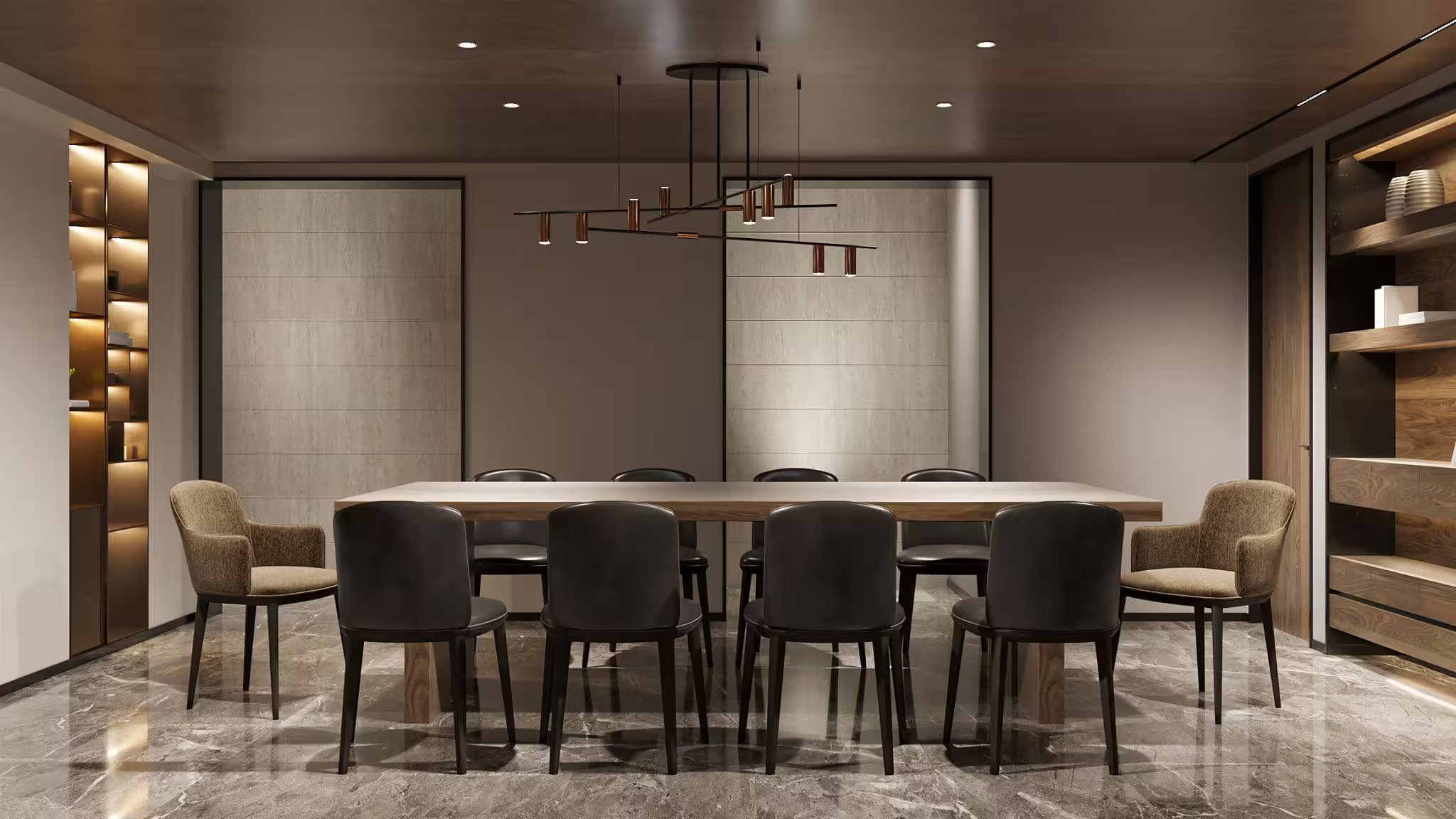
Buying a matching dining set — table, chairs, and sideboard all from the same range — seems like the safest option. Everything coordinates. Nothing clashes. And then somehow the room feels flat and slightly corporate.
The problem isn’t matching per se. It’s that perfectly matched furniture has no visual tension, no sense that someone made considered choices. It looks like a showroom floor because, essentially, it is one.
Mixing works — but not randomly. The rule that makes it work: mixed pieces need at least one governing principle. Share a leg finish (all dark-stained wood, say), or a common silhouette (all mid-century), or a consistent material family (wood and rattan). Without that connective thread, mixing just looks chaotic.
In practical terms: two or three different chair styles work well together if they share that common element. Upholstered seat pads in the same fabric across different chair frames create cohesion. An end chair that’s slightly different from the side chairs adds interest without losing harmony.
For inspiration on how this plays out across different aesthetics, the modern dining room decor ideas gallery shows what considered mixing looks like in practice.
Wall and Window: The Details That Actually Finish a Room
Bare walls above a certain scale start to feel unfinished. But the solution isn’t just “hang something” — scale matters. A small print centred on a large dining room wall looks lost. Artwork in a dining room should be confident in size, or grouped thoughtfully if smaller pieces are what you have.
Window treatments are often treated as optional decoration in dining rooms. They’re not. Bare windows in a dining room create two problems: glare during daytime meals (especially if the room faces west or south), and a sense of darkness and exposure in the evening. Even simple linen curtains hung close to the ceiling and falling to the floor — not to the windowsill — change the proportions of the room entirely.
The detail most often missed: curtains hung too low and too narrow. Hang the rod 10–15cm above the window frame, extend it 15–20cm beyond the frame on each side, and let the fabric fall to the floor. The window looks larger. The ceiling feels higher. The room feels finished.
Why Flat, Uniform Rooms Feel Cold
A dining room where every surface is the same material and finish — smooth painted walls, polished table, metal chairs, hard floor — reads as sterile. There’s no warmth because there’s nothing tactile.
Texture does what colour often gets credit for. A linen tablecloth, rattan place mats, a wool rug, an upholstered seat — these elements absorb light differently and create visual depth without the room feeling busy. You don’t need all of them. Even one or two soft-textured elements in a room that’s otherwise hard surfaces makes a noticeable difference.
The easiest add: a runner or cloth on the table surface, even when not in use. It grounds the table, softens the look, and costs almost nothing.
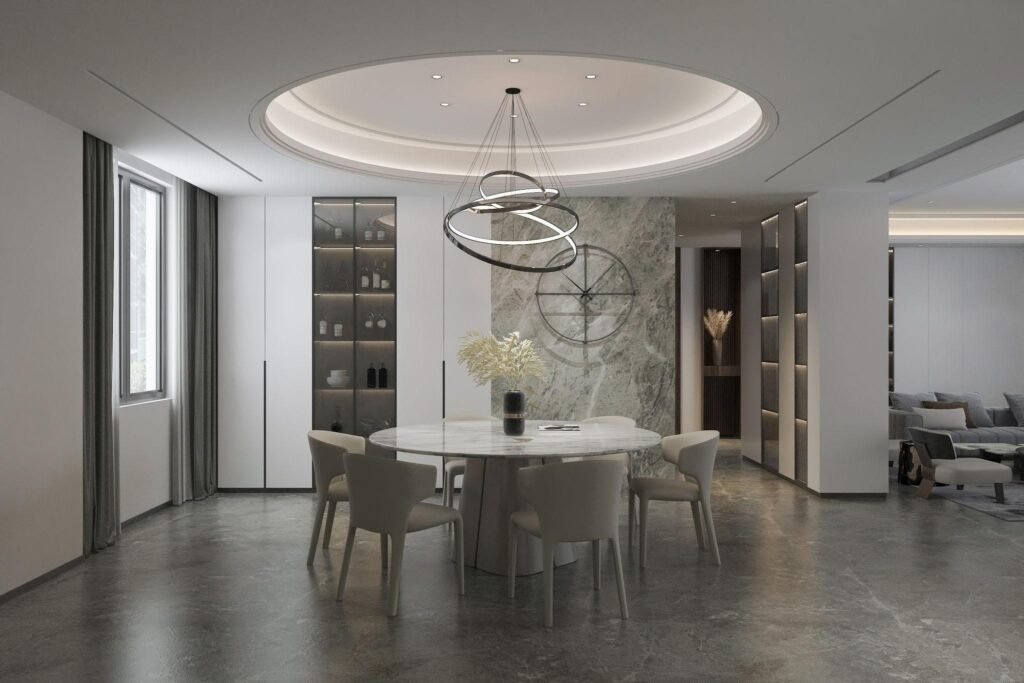
Small Dining Rooms — Specific Mistakes Compact Spaces Make
Small dining rooms have a particular set of problems, and the standard advice (“keep it light, keep it minimal”) isn’t always right.
The most common mistake in a compact dining room is choosing furniture that’s too small in an attempt to make the room feel larger. A tiny round table and delicate chairs in a small dining room just make the space feel uncertain. A well-proportioned table that fits the room correctly, with proper clearance maintained, looks more resolved — even if it occupies more visual space.
One counterintuitive principle: small dining rooms can carry a larger, more dramatic pendant than you’d expect. A statement fixture at the right height pulls the eye up, makes the ceiling feel taller, and gives the room a sense of intention. A modest undersized pendant in a small room looks like it’s hiding.
For more on making smaller spaces work, there are practical ideas in this piece on small dining room decor hacks.
The Table Finish Problem Nobody Talks About
A dining table gets used. It gets plates, glasses, the occasional hot dish, the inevitable spill, the daily wipe-down. A table finish that can’t handle any of that is a problem you’ll live with every day.
High-gloss lacquer shows every fingerprint and ring mark. Untreated or poorly sealed solid wood scratches and stains. Some veneer finishes look beautiful in a showroom and deteriorate quickly under normal use.
Before buying, ask specifically about water resistance and scratch resistance. An oil-rubbed or wax-finished solid wood table will develop a patina over time that many people find beautiful. A high-gloss finish that chips and marks within a year is just dispiriting.
This applies particularly to homes with young children or anyone who actually uses the dining room regularly. A budget dining room makeover doesn’t mean compromising on practicality — there are durable options at every price point.
A Few Things Worth Knowing Before You Buy Anything
The severity of these mistakes varies enormously. A dimmer switch is a fifteen-minute job and costs almost nothing. A rug in the right size is a moderate expense. A dining table with a problematic finish might need replacing entirely. Treating all of these as equivalent fails you as a reader — so it’s worth being honest about which fixes are minor adjustments and which require more commitment.
Start with lighting. A dimmer switch and a pendant at the right height will change how the room feels more than almost any other single intervention. Then the rug, if yours is too small — it matters more than it seems like it should. Everything else can follow in time.
If you’re starting from scratch or want to see how these principles come together across different styles, the luxury dining room inspiration and minimalist dining room styling sections show what a well-resolved dining room actually looks like when the fundamentals are right.
Frequently Asked Questions
An undersized rug. Most dining room rugs are sized for the table footprint rather than the table-plus-chairs footprint. The correct size means all chair legs remain on the rug when chairs are pulled back — typically at least 60–75cm beyond the table on every side.
Large enough that all chair legs stay on the rug when chairs are pulled out from the table. For a standard six-seater dining table, that usually means a rug of at least 200cm x 300cm. Measure your table, add 60–75cm on each side, and that’s your minimum.
The bottom of the fixture should sit around 75–90cm above the tabletop. Dining rooms allow lower hanging than other rooms because no one walks underneath — the pendant sits over a fixed piece of furniture.
Not necessarily, and often they’re better when they don’t. Mixed dining chairs work well when the pieces share a governing principle — a consistent leg finish, a common silhouette, or a shared material. Without that, mixing becomes visual chaos.
Warm dimmable lighting, comfortable seating, a rug that properly grounds the space, and layered texture across surfaces. The lighting matters most. A dimmer on your main fixture is the single highest-return change most dining rooms can make.
Usually it’s one of a few underlying issues: the rug is too small, the lighting is too harsh or hung too high, the chairs are uncomfortable, or the room lacks texture variety. The dining room design mistakes checklist above covers the most likely culprits — most of them are more fixable than they first appear.